In the fall of 2008, we planted hyacinth bulbs in our yard. Many of those bulbs are blooming for the second time this week. I was surprised to see them bloom a second time with only slightly less vigor than last year, because I have read that we don’t get enough winter chill in our climate to stimulate hyacinths to re-bloom year after year. The hyacinth bulbs I have planted in prior years have tended to come back with less and less vigor each year until they die completely.
Although our hyacinths have been low maintenance flowers otherwise. We get enough rain in the winter months when they are in bloom that we do not need to provide them with supplemental watering. Also, I have not fertilized them.
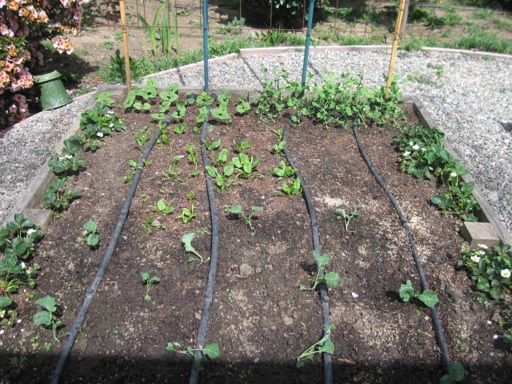
The blue/purple hyacinth flowers are the most stunning to look at, and this color has re-bloomed the best out of all the hyacinth colors we planted. Although the white hyacinth flowers have by far the best fragrance. We planted more blue/purple and white hyacinth bulbs last fall in different locations (below picture). Those bulbs are a few weeks behind the 2008-09 crop in their bloom cycle.

February 28 2010 | Hyacinths | No Comments »


I added a new Arctic Rose nectarine tree to my collection of backyard fruit trees a few weeks ago. The first picture above shows what the tree looked like after I brought it home from the nursery, and the second picture shows how it looked after I pruned it severely, cutting off most of the branches. I have read several resources over the past year about pruning fruit trees. Most of these sources advise home growers to prune fruit trees regularly, especially in the first few years after they are planted when they are still small.
I have always wondered why the branches of many backyard fruit trees bend and break under the weight of the fruit that they bear. Why is it that these trees have not evolved strong enough branches to bear the weight of their fruit? Put another way, why it is that these fruit trees have evolved to bear more fruit than their branches can support the weight of?
The answer is that most of the fruit trees that people grow for food today are not entirely the result of natural selection. Breeders have bred fruit trees such as apples, pears, and peaches to bear large fruits. The wild versions of the fruit trees that we know and love are much more able to support the weight of their fruit, partly because the fruit they bear is much smaller than the cultivated varieties we cherish. For example, today’s large cultivated apples are probably descended from crabapple trees, which produce fruits that are only about 1-2 inches in diameter. Wild peaches trees that grow in their native China produce fruits that are much smaller and more sour that the peaches that are cultivated throughout the world today.
Although fruit tree breeders have been very successful at improving the size and flavor of many modern cultivars of fruit trees, they have not improved the strength of the branches of fruit trees. The only way to do that is to prune often and heavily. Pruning the branches of a tree stimulates the tree to thicken and strengthen the shortened branches that remain, making them much better able to support the weight of a heavy load of large fruits.
I am now pruning my fruit trees 1-3 times a year so that they can support the weight of their fruit without needing supports or causing branch breakage. Depending on how fast an individual tree is growing, I sometimes prune the same tree as often as 3 times per year, in the winter, in the spring, and in the summertime. Many of my fruit trees grow rapidly in the spring after a winter prune. Spring and summer pruning does a good job of reducing the vigorous growth rate of trees. Frequent pruning has kept our fruit trees small so that it is easier to spray them (if needed), net them, harvest the fruit, and perform subsequent pruning.
I have read repeatedly that is especially important to prune peach and nectarine trees heavily, because they grow vigorously and produce many more fruits than they can support. I think that at least 2/3 of the branches of a peach/nectarine tree should be removed each year to control its size and fruit production. If pruning doesn’t do enough to reduce the number of peach or nectarine fruits a tree produces, I will thin the fruits to about 4-6 inches apart in May-June. Thinning the fruit greatly reduces the likelihood of branches breaking. Also, in the years that I thinned my peaches, my O’Henry peach tree has produced peaches that are much larger in size than in the years I have not thinned them.
February 20 2010 | Fruit and Peaches/Nectarines | No Comments »


Last spring, I planted rainbow carrot seeds in our vegetable garden. I planted a second crop of rainbow carrot seeds in our garden last September. This week, I harvested the remaining carrots from the spring crop. The first picture above shows some of the red, purple, white, and yellow carrots I harvested. The only color of carrots I didn’t harvest was orange!
These carrots had been in the ground a long time (nearly 10 months). Many of them had grown to be very large. And I don’t remember ever fertilizing them. They don’t seem to need it. Carrots are one of the lowest maintenance vegetables that I have grown. The carrot in the bottom picture has a green top, because that part of the carrot was protruding above the ground.
I have heard that carrots can be left in the ground over the winter, and that the cold winter weather stimulates them to get sweeter. This week we received nearly 6 inches of rain. So I decided to harvest the rest of the spring carrots, because I was concerned that they might start rotting in the ground. In fact, some of them already had a few brown spots.
Some of our carrots were forked. Carrots tend to get forked when their roots run into rocks or hard dirt clods. Also, some of our carrots had split open, possibly because of too much watering during the growing season. But one of the nice things about vegetables is that even the less than perfect looking ones are still edible. Once they are sliced and cooked, who can tell the difference anyway?
January 24 2010 | Carrots | 1 Comment »


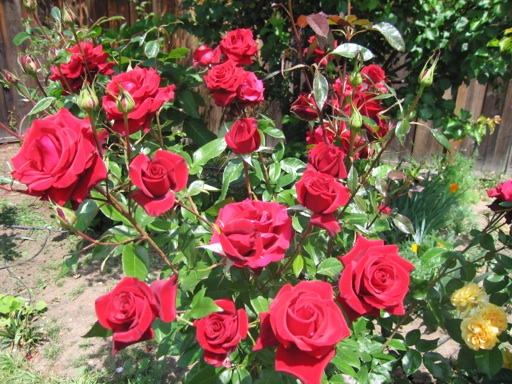
As the daylight hours dwindle in autumn, so do the blooms in our garden. But a few of our plants are still managing to put on a nice show of flowers. Some of our rose bushes are producing their last bloom of the year, including our black magic roses as shown in the first picture. I pruned off most of this season’s growth from this particular rose bush back in mid-August. In just two months, it grew back rapidly and produced another flush of flowers.
Last spring, we planted cockscomb flower seeds in a pot and in our raised bed vegetable garden. They grew better in the pot. It took them 5 months to grow to full size and begin to flower, which they began to do in September. They are still looking good and holding on to their red flowers (if you can call them flowers).
October 18 2009 | Cockscomb and Roses | 2 Comments »

It may not be possible to produce 100% of one’s fruit and vegetable needs in a suburban backyard garden. But after my second season of growing a vegetable garden, I have been thinking about exactly how much our vegetable garden has reduced our food bill.
Below I have listed the approximate amount of produce we have grown this year in our vegetable garden and the cost to buy the equivalent amount of produce in a local grocery store. The prices that grocery stores charge for produce vary greatly from store to store, from region to region, and at different times of the year. The prices per pound of the various items of produce I have described below are approximate average prices that grocery stores in my area have charged this year.
This year, for example, our strawberries produced about a 1 pound of berries per week from mid-May through mid-August and about 0.25 pounds per week after that through the present. Strawberries typically cost at least $3 per pound in our area in the spring, summer, and fall. That’s at least $50 worth of strawberries.
We harvested at least 35 pounds of tomatoes this season. At a price of $2 per pound, that’s about $70 worth of tomatoes. We turned most of those tomatoes into a pizza sauce that we use on homemade pizza as well as in pasta dishes.
We have harvested and eaten about 14 pounds of green beans from late June until now. That doesn’t include the dried beans I harvested last week. At a price of $2.50 per pound, our plants have produced about $35 worth of fresh green beans.
We have grown about 30 carrots that weighed about 15 pounds. At $1.20 per pound, that’s about $18 worth of carrots. We harvested at least 20 zucchinis. At $2 per pound, that’s about $40 worth of zucchinis from our garden. We picked about 8 pounds of eggplants. At $3 per pound, that equals about $24 dollars worth of eggplants. We harvested about 10 pounds of onions that would have cost about $13 to purchase. We also harvested about $10 worth of bell and jalapeno peppers, about $10 worth of basil, about $10 worth of corn, about $5 worth of broccoli, and about $5 worth of spinach.
That equals a total of about $290 worth of produce from the vegetable garden we planted in our yard to replace a 10′ x 20′ lawn. I estimate that I spent about $120 to buy fertilizer, seeds, transplants, and other supplies to start and maintain our vegetable garden this year. It’s hard to estimate how much of our water bill comes from watering the vegetable garden, but a really rough estimate is about $25 from April through October.
Subtracting out the costs, our vegetable garden netted us about $145 dollars this year. That does not amount to a tremendous savings on our food bill. However, gardening is perhaps one of the few hobbies that saves a hobbyist money rather than costing the hobbyist money. Also, I figure that I can increase our yields next year by cutting out some of the plants that did not produce quality produce, like honeydew melons, and planting more of the plants that were easy to grow and inexpensive to plant by seed or transplant, like carrots and onions.
The yield from our pepper plants this year was disappointing compared to last year and prior years when we grew them in pots. This year, our peppers got crowded by the nearby tomatoes and beans. I think I can get them to produce more next year by giving them more room to grow and by fertilizing them more. Optimistically, I think that our vegetable garden, which consists of a 6′ x 7′ raised bed, a 6′ x 8′ raised bed, and a bunch of pots, has the potential to produce $400-$500 dollars worth of produce in a good year at today’s prices.
October 11 2009 | Vegetables | 1 Comment »


We have been harvesting beans from our pole bean plants since late June. During the summer, they were producing more beans than we wanted to eat, so I didn’t harvest them all. They are starting to wind down their production of beans now, but there are many bean pods left on the vines that have dried up.
Today, I spent about an hour harvesting the dried bean pods and removing the seeds from them. Each fall, I save bean seeds from the dried up beans pods to plant as next year’s crop of pole beans. I place the bean seeds in a zip-locked bag marked with the date I harvested them. Then, I put the bag in a drawer in our kitchen for storage until next spring.
Beans are the only seeds I harvest from our vegetable garden to re-plant for next year. Bean seeds are very easy to harvest, because they are large seeds, and they dry within the pods while they are still on the vine. Other types of vegetable seeds are much smaller and are more of a challenge to pick and dry.
I always make sure to harvest the seeds from bean pods that are completely dried up. The dried up pods crumble in my hands when I break them open. I have noticed that if the bean seeds inside are not completely dry and hard, mildew may start to grow on them while they are in storage.
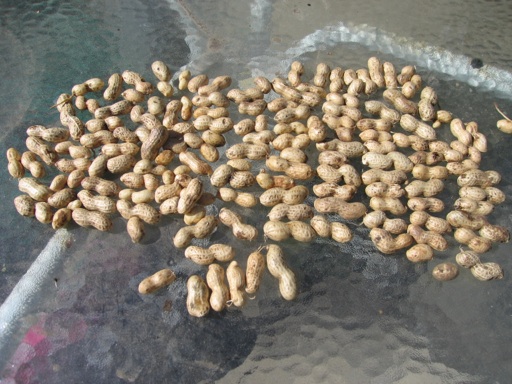
This year I planted mainly Romano (Italian) beans and some Blue Lake pole beans. The black beans shown in the third picture above are the Romano beans. These types of beans are usually grown for harvest as green beans. But I think the dried black bean seeds from the Romano bean plants can also be cooked and eaten. We have too many dried bean seeds to plant next year in our relatively small vegetable garden, so I am going to try cooking some of them and using them in Mexican dishes.
October 04 2009 | Beans | No Comments »


Yesterday, my mom and I harvested about 70 Comice pears from a small tree in my backyard. Our tree is crammed into a small space in between our house and a fence that is only about 6 or 7 feet away from the house and runs parallel to the house. The tree has grown upright in between the house and the fence. This tree was planted by the previous owners of the house. They didn’t pick the best spot, because the tree doesn’t have enough room to grow any wider. However, our Comice pear tree has managed to produce an abundance of pears nearly every year (except the years I didn’t net the tree). This is an example of how a fruit tree can be grown in a small space in a backyard and still produce high quality fruit.
In my opinion, Comice pears are the best tasting variety of pear. In fact, they are one of the best tasting fruits. The comice pears we have harvested from our tree taste even better than Bartlett pears. Our comice pears are very sweet. They are sweeter than Bartlett. Bartlett pears tend to have a bit of tartness, although I am a big fan of those pears as well. We also have a Bartlett pear tree.
Like all pears, Comice pears need to be picked while they are still unripe, and then ripened indoors. The worst thing about Comice pears is having to wait so long to eat them. Comice, Bosc, and D’Anjou pears need to be kept in a refrigerator for at least a month after harvest. After a month in cold storage, they can be brought to room temperature to ripen properly.
September 28 2009 | Pears | 4 Comments »
« Prev - Next »