Archive for July, 2009
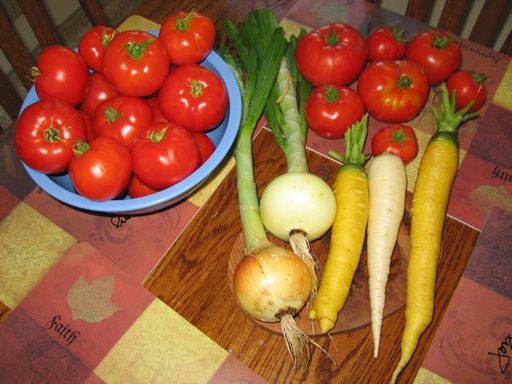
As shown in this picture, we harvested yellow and white carrots, walla walla onions, a bunch of big beef and early girl tomatoes from our vegetable garden today. We are making homemade pizza sauce, minestrone soup, and vegetable lasagna with our harvest. We saved money by growing many of the ingredients for these recipes ourselves, and all of these vegetables were easy to grow. Beyond planting in the spring and then harvesting months later, maintaining our vegetable garden did not require a lot of effort.
The automatic watering system in our vegetable garden saves us the trouble of having to water regularly. I fertilized multiple times after planting. But once the plants started growing rapidly, I figured there wasn’t a need for much additional fertilizer. And I only needed to do a little bit of weeding. I think that the weeds just didn’t get a chance to grow, because I planted the vegetables relatively close together. Once the vegetable plants started to grow together, there wasn’t much sunlight to stimulate weed growth in between them.
I just planted another set of carrot seeds. July and August is the time to plant carrot seeds for an autumn and winter harvest. One nice thing about carrots is that they hold well in the ground after they reach maturity without rotting or losing quality. That means you can leave them in the ground for months until you are ready to harvest them.
July 26 2009 | Carrots and Onions and Tomatoes | Comments Off on Summer Harvest
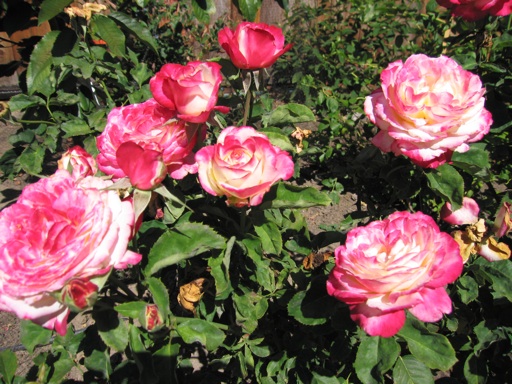
This is a picture of a Double Delight hybrid tea rose bush growing in our backyard. I just planted this bush last spring, and it has bloomed several times since then.
The flowers of Double Delight are white with beautiful deep pink edges. Its flowers have a strong sweet fragrance. Most of the roses in our yard have either no scent or a very subtle scent. Double Delight is one of the few roses we have with a strong scent. Mr. Lincoln also has a great fragrance, but it smells more musky than sweet.
Double Delight seems to need a lot of water like most other roses. I have been watering it every other day, and it has grown quickly ever since I planted it. Although the leaves of our Double delight are not as attractive as some of our other roses, the beauty of its flowers makes up for what it lacks in foliar beauty.
July 25 2009 | Roses | Comments Off on Double Delight
Last year, I experimented with growing cantaloupes. Although a few cantaloupes developed (one nearly grocery stored size), they weren’t edible, because they didn’t develop any sweetness. Since then, I have read that melons need a lot of summer warmth to sweeten up properly. They are grown successfully in hot summer climates where the high temperatures regularly exceed 90 degrees F. In our area, the summer highs average around 80 degrees F.
This year, I planted a type of cantaloupe (i.e., muskmelon) called Hale’s Best. I have heard that this particular variety of cantaloupe is more likely to ripen in a mild summer climate. I also planted the cantaloupes about 6 weeks earlier than last year to give them a head start. I planted seeds in early April and transplants from a nursery in mid-April to see which would grow better. Both are doing well so far.
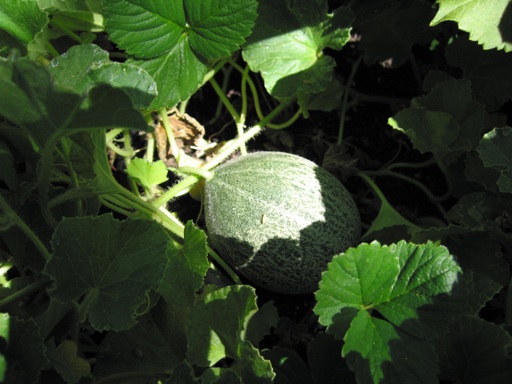
A few cantaloupes are already developing on the vines (see first picture). The melons seem to be developing at least few weeks earlier that last year’s melons. I can’t wait to see if they ripen this time. I am hoping that planting them earlier will give them enough time to reach full sweetness. Home grown melons are supposed to be far more sweet and flavorful than the typical grocery store melon.
I also planted honey dew melons by seed. I selected a variety called Sweet Delight that was being sold at a local nursery. I know that honey dew melons may need even more heat than muskmelons to ripen fully. But I decided that it would be fun to try at least once.
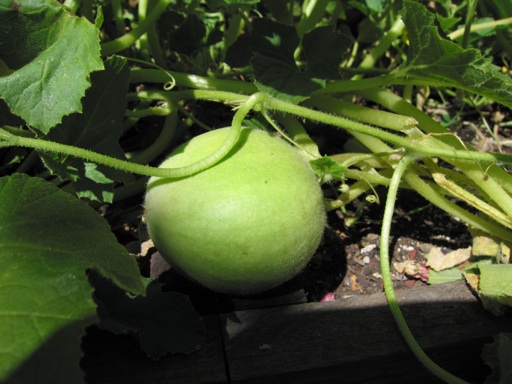
I set out several honey dew and cantaloupe seeds in March. Birds ate most of those soon after they sprouted. I then planted a second round of honey dew and cantaloupe seeds a few weeks later in early April. The second time, I put bird netting over the seedlings. Most of the seeds in this second batch managed to sprout and grow into vines that are now producing small melons. The second picture shows one of the honey dew melons on the vines.
July 25 2009 | Melons | Comments Off on Another Try with Melons
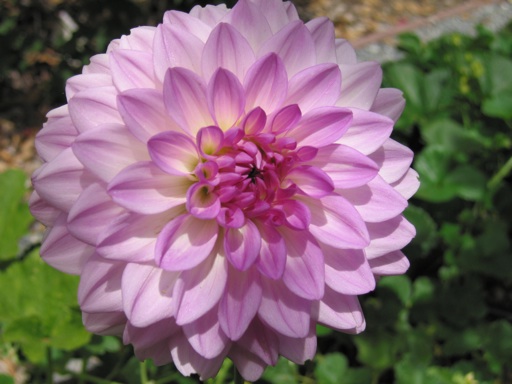
The top picture shows a really interesting purple and white dahlia I am growing this year. I have never had any luck growing dahlias in the ground. As soon as the dahlias sprouted in the spring time, the snails would devour them. They barely had enough time to grow one leaf before they were eaten. Putting snail poison around the dahlias bought some time, but as soon as it began to wash away, the dahlias would get eaten. I just couldn’t be bothered to reapply the snail poison every week or two. The full grown dahlias I planted in the ground didn’t fare much better.
This is the first time I have been successful growing a dahlia. It is growing in our raised bed vegetable garden, which has copper tape all around the wood borders to deter snails and slugs. The copper tape works most of the time, although occasionally one gets in.
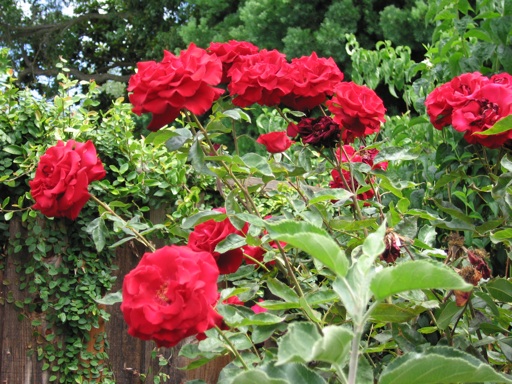
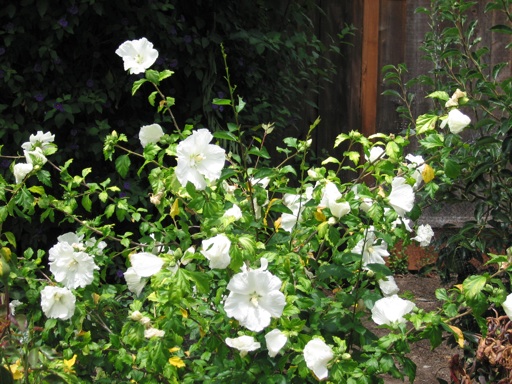
The second picture shows our back magic tree rose, which has been in its second bloom of the season for weeks. This rose is one of my favorite roses, because it’s flowers are beautiful, and they last for so long. The third picture shows a white rose of sharon that is now in full bloom in our back yard. Our roses and rose of sharon are all growing in the ground (not in the raised beds). Our snails and slugs don’t seem to be interested in eating these plants.
July 18 2009 | Dahlias and Rose of Sharon and Roses | Comments Off on July Flowers
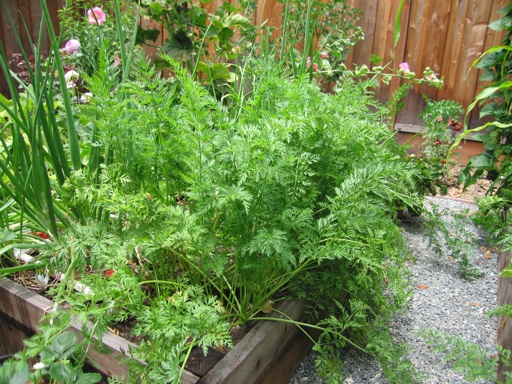
Carrots have been one of the most enjoyable vegetables to grow in our garden. Back in early April, I planted seeds for red, yellow, white, and purple carrots. Most of the seeds sprouted as extremely tiny seedlings, but they grew very fast. After 3 months, they have grown so large that they are crowding each other (see top picture).
Some of our carrots went to seed before they developed more than a tiny little carrot. But most of them have not seeded yet. Carrots are supposed to be a spring or fall crop, because they tend to go to seed too soon in hot summer weather. Perhaps our relatively mild summers (highs averaging around 80 F) have kept most of them from seeding prematurely.
Many of our carrots are ready to harvest. On the seed package, it says 65-75 days to maturity, but our carrots seem to be taking longer than that. Also, carrots appear to last in the ground for a long time without going bad or losing flavor.
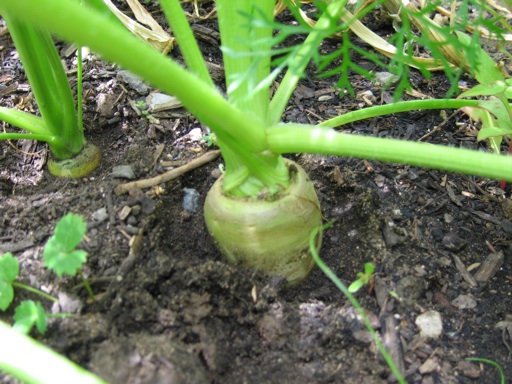
I determine when carrots are ready to harvest by digging around the top of the root to see when the carrot appears to have grown to a full size. (see bottom picture) Harvesting carrots is very fun, because it’s always a surprise when you pull them up and find out how big they are.
July 18 2009 | Carrots | Comments Off on Carrot Patch
Next »