Archive for September, 2008
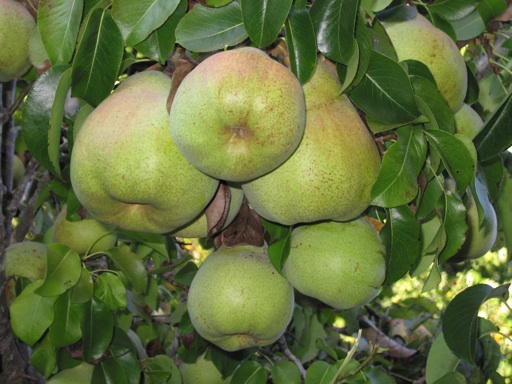
This is a picture of a Comice pear tree growing in our yard. This year, it is full of fruit. The pears are nearly ready to be picked. In our area, late September is an ideal time to harvest Comice pears.
Comice pears should be picked when they are still green and hard. When I first harvested pears from this tree a few years ago, I let the pears ripen at room temperature for several days. That turned out to be a mistake. Even after a few weeks, the pears were still very hard, and they tasted terrible.
Years after that, I read that many pears, such as Comice and Bosc, need to be stored in refrigeration for about 3-4 weeks after harvest, and then brought back to room temperature to ripen. Unlike Bartletts, Comice pears do not ripen properly at room temperature without prior refrigeration.
Last year, I picked a few Comice pears from our tree and refrigerated them for a month after harvest. Then, I took them out of the refrigerator and let them ripen in a fruit bowl for about a week. They were delicious. Properly ripened Comice pears are very sweet. They almost taste as good as Bartletts.
Back in June, I put bird netting around most of the tree. The netting keeps the local squirrels from eating the fruit. Some years, I lost the entire crop to squirrels. They typically remove the pears months before they are ready to pick. This year, I haven’t seen any half-eaten fruit lying around the base of the tree.
September 22 2008 | Pears | Comments Off on Comice Pear Tree
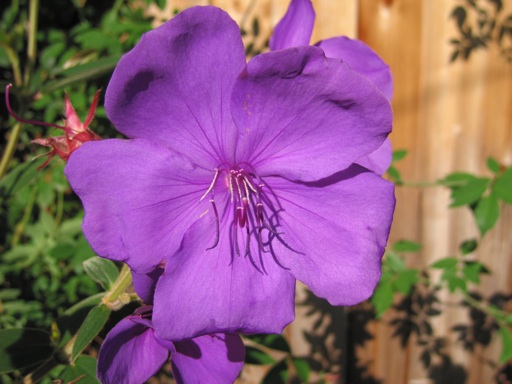
Princess flowers (also known as Tibouchina) are very attractive perennial shrubs. They produce beautiful purple flowers from late summer into autumn, and they have attractive fuzzy green leaves. Princess flowers are an attractive front yard plant, because their flowers are so eye-catching.
Unfortunately, princess flowers are also frost sensitive. I planted a few princess flowers a couple of years ago. During a severe freeze 18 months ago when the temperature here fell into the mid-20s (F), they all died to the ground. The plant in this picture is the only one I didn’t pull up after that. It’s growing back now and blooming for the first time since the freeze.
I have noticed that a lot of people in the Bay Area have planted princess flowers next to their houses. The ones planted next to buildings seem to have fared the freezing weather better. Perhaps, warmth from a nearby building helped to keep the plants from freezing.
Princess flower seems relatively easy to grow otherwise. It prefers regular watering, but it seems to be somewhat drought tolerant when established.
I have read that princess flowers prefer full sun. Although, I have seen them flourish in partly shady locations in other peoples’ yards.
Princess flower shrubs usually grow very quickly. As they grow, their branches grow long, lose their leaves, and don’t produce any more flowers. Over time princess flower shrubs can develop too many leafless and flowerless branches, making them look spindly and unattractive.
They really need to be pruned often to keep them looking good. After pruning, the shrub develops new growth quickly at the cuts and starts to fill out again with green leaves and eventually flowers.
September 16 2008 | Princess Flower | Comments Off on Princess Flower
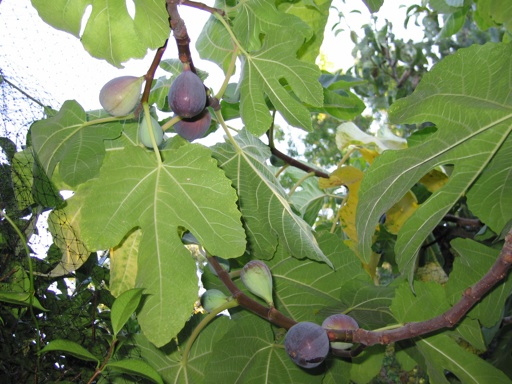
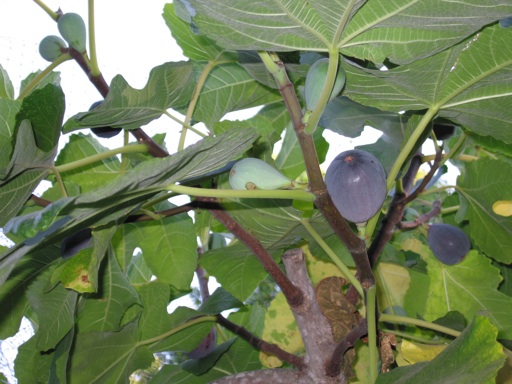
Our black mission fig tree is full of a second crop of figs this month. A first small crop comes in June, but the September crop is always much larger. Fig trees are one of the few fruit trees I know of that produce multiple crops in a single year. Lemons are another example.
Figs trees can get very large. Our neighbor has a big fig tree. However, our fig tree is crammed into a narrow alley between our house and a fence where it barely has enough space to grow. Yet, it still gets decent crops of figs every year. I don’t know why the former owners thought that this was a good spot to plant a tree. I wouldn’t have planted it there. But now that it’s there and somewhat mature, I am going to leave it there, rather than try to transplant it.
I keep our fig tree trimmed to about 8 feet tall and about 6 feet long. That also makes the tree easy to net and maintain. Netting the tree is a must as the fruit begins to ripen, because the squirrels in our area love to eat figs. They often take one bite out of each fig and then discard it. That’s frustrating, because it’s such as waste.
The figs I have seen for sale in grocery stores sometimes look shriveled. Our home grown figs are so tasty and fresh. I can’t imagine buying shriveled ones. I rarely have a craving to eat more than one or two figs at a time. So I have been learning what they can be used for. Apparently, figs can be used in a wide variety of recipes, including fig newtons and fig bars, which are my favorite fig treats.
September 11 2008 | Figs | Comments Off on Black Mission Figs
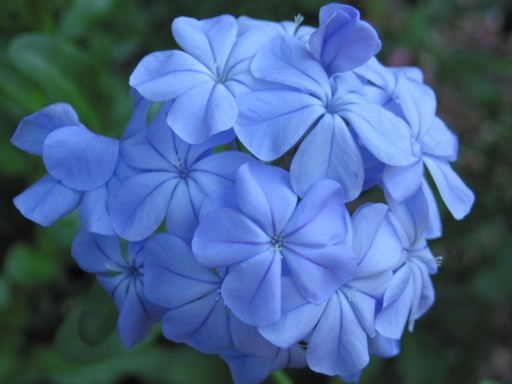
This is another photograph that I took today. It’s a picture of a cape plumbago bush in our yard. It is full of light blue flowers right now. It started blooming in July.
This plant is amazing, because it grows and thrives with so little water. I rarely water this plant, and it hasn’t rained here since February! Yet, it grows and blooms anyway. Maybe it gets some hydration from nearby plants that I do water.
Cape plumbago grows fast and needs regular trimming. It’s an incredibly resilient plant. I transplanted it once and didn’t get enough of its roots. After that transplant, it wilted and died back to the ground. But it regenerated a few months later.
Cape plumbago is frost sensitive. This bush died back again during freezing weather in January 2007. I thought it was dead then. But only a few months after the freeze, it started to grow back yet again.
September 06 2008 | Plumbago | Comments Off on Cape Plumbago
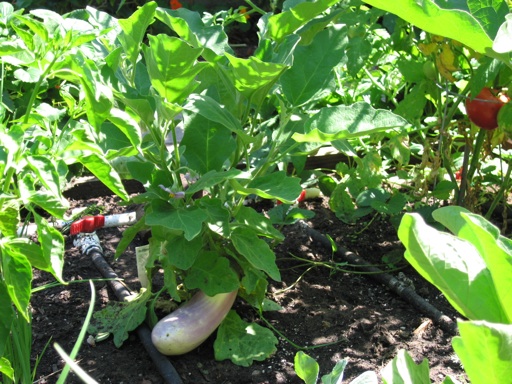
This picture is a photograph of an eggplant that is growing in one of our two raised garden beds. The eggplant variety is Lavender Touch. I selected this variety because the fruit looks so different from a typical eggplant.
I planted three eggplants as transplants in our garden on July 4. I have been watering them every few days and fertilizing them with water soluble fertilizer once a week.
I was a bit skeptical that these eggplants would produce fruit, because they were planted so late. I have never grown eggplant before this year, and I am thrilled at how easy they are to grow. They have grown substantially, especially in the last few weeks, and they are producing fruit. They seem to be thriving in the hot weather we have been experiencing. The high temperatures here have been mostly in the 90s for the past two weeks.
I have read that, in our climate, many warm weather annual fruits and vegetables can be planted from early spring through early summer, including beans, corn, and squash. I am thinking about spacing out my plantings of some annual fruits and vegetables next year. Perhaps if some transplants are set in the ground in March, some in May and some in July, I can have harvests over a longer season.
Eggplants and peppers seem to require several months of warm weather. Gardening publications typically recommend setting eggplant and pepper transplants in the ground in mid-to-late spring. However, my experience shows that eggplants planted in early summer can produce fruit, at least in our climate.
September 06 2008 | Eggplant | Comments Off on Lavendar Touch Eggplant
« Prev