Archive for September, 2008
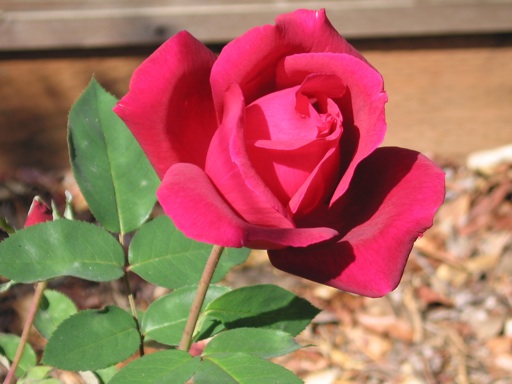
I purchased this Mirandy hybrid tea rose from a local discount garden center a few months ago for $6.50. It seemed like a great deal, even though the bush was small and looking a bit scraggly. I figured that I could get it to recover with a little bit of care and a regular watering schedule.
Roses seem to like being watered everyday during our rainless summer months. I have been watering all of our roses daily using an automatic micro-spray watering system. This Mirandy rose has doubled in size since I bought it in July. It was full of flowers about a month ago. A few weeks ago, it started growing a second set of blooms. The second set of roses just started opening two days ago.
The flowers have a deep red color with a hint of purple and a sweet fragrance that I typically associate with red roses. They are near perfection in terms of their looks. However, the flowers open quickly, and they typically lose their petals within a few days after opening.
September 29 2008 | Roses | Comments Off on Mirandy Rose
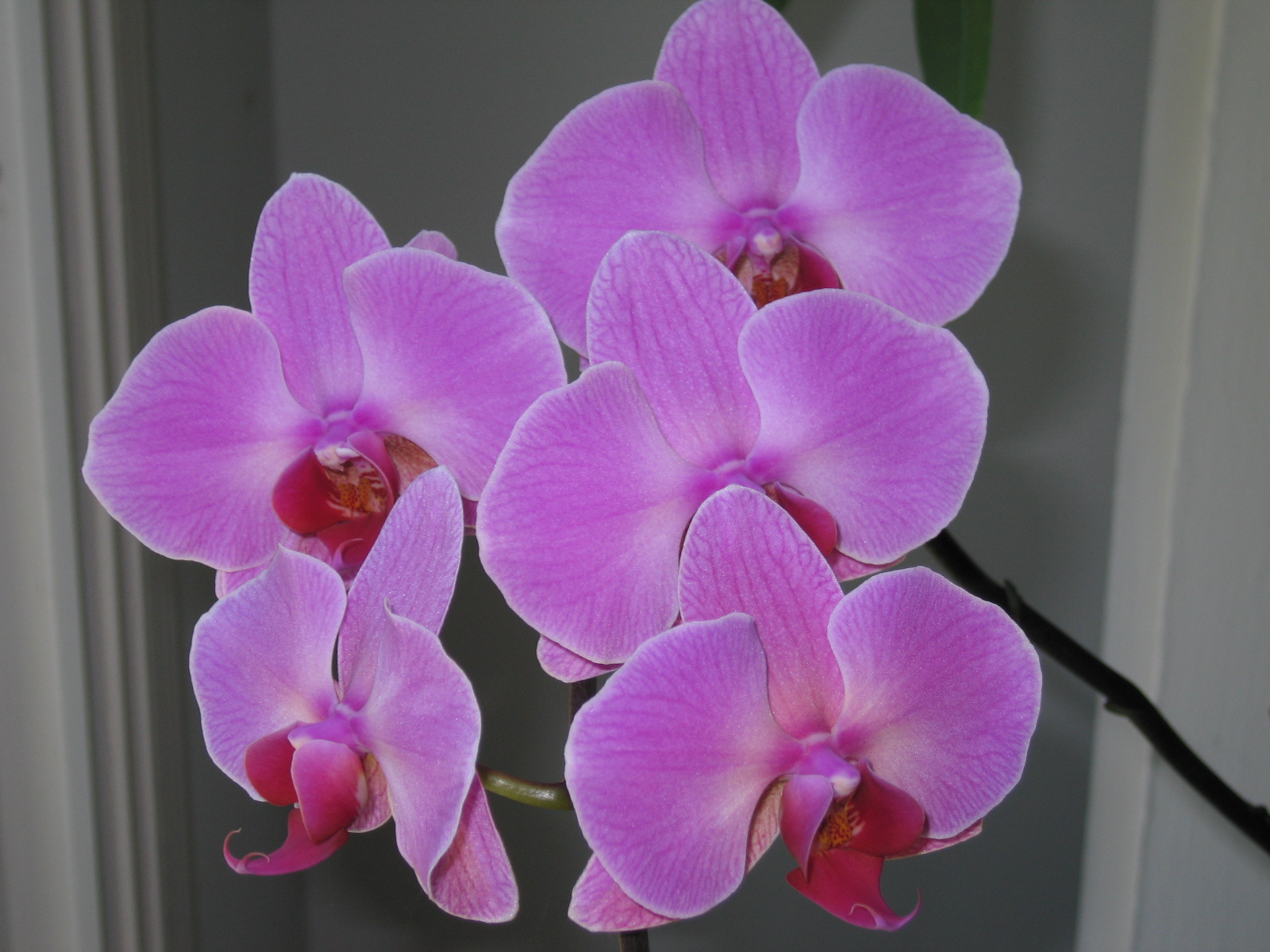
We bought this orchid plant last fall. It had several blooms on two flowering stems. It looked great at the time, like most orchids do when they are sold to consumers. But after a few weeks the flowers began to fade, and the flowering stems eventually stopped generating new flowers.
My partner then decided that he was going to get this orchid to bloom again. He first repotted it in a larger container with tree bark. Then, he began to fertilize it regularly. Every week, he fills our kitchen sink with water and a dash of orchid fertilizer, and soaks the orchid container in the water bath for several minutes.
After a few months, the orchid began to grow a new leaf. I was amazed, because I have not been able to get an orchid to grow a new leaf, let alone a new set of flowers. It has now produced several new leaves.
A few months ago the orchid began to sprout a new stem. The stem has taken months to grow and generate buds. The buds on the new stem just began to open a few days ago. They look amazing.
September 28 2008 | Orchids | Comments Off on Orchid Blooming Again
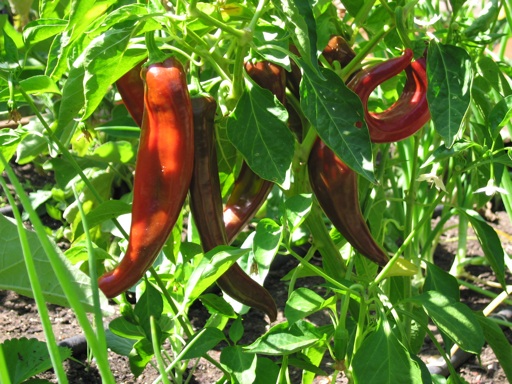
The fruit on the anaheim chili pepper plant in our vegetable garden is turning red this week. I have only seen green Anaheim peppers being sold commercially. This plant has taught me that Anaheim peppers are not fully ripe until they turn red.
Apparently, ripened red Anaheim peppers have more heat than the immature green ones. Although, Anaheim peppers are relatively mild flavored chilis. We use them as a flavor ingredient to spice up a variety of dishes, especially in Mexican and Indian recipes.
We are also growing bell peppers this year. I started growing bell peppers last year, because the red, orange, and yellow bell peppers that are sold commercially are so expensive. I was surprised to discover that green bell peppers are just immature bell peppers that would have turned red, orange, yellow, or some other color if they had been left to fully ripen. I had assumed that the colored peppers were different varieties.
I think that peppers have a much greater visual impact in a garden when they are allowed to turn red, orange, or yellow. Home grown bell peppers that are ripened to their full coloring also have a wonderful fragrance and a fuller flavor. Plus, the economy of growing fully ripened peppers is greater, and it only requires a little more patience.
September 24 2008 | Peppers | Comments Off on Fully Ripened Peppers
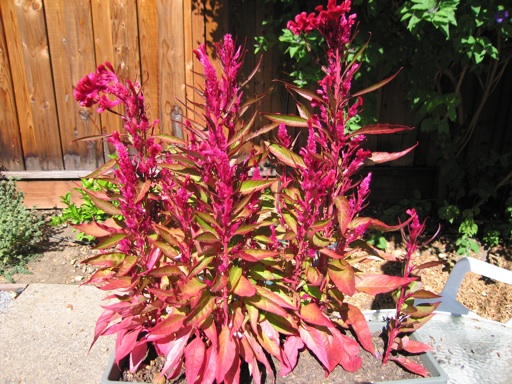
This photo is a picture of cockscomb plants (Celosia) that are growing in container in our yard. Earlier this year, a friend sent us a pack of tiny cockscomb seeds that she harvested from her cockscomb plants last year. We planted them back in April, and they are now blooming.
These cockscombs have unusually shaped red flowers and reddish leaves. Our plants only reached about 18 inches tall, probably because they are growing in a small container. But they have the potential to grow up to about 3 feet tall.
We have been told that cockscombs can easily self-propagate and may soon be popping up all over the yard. That’s part of the reason I decided to grow them in a container. I think I can control where the seeds fall more easily this way.
September 22 2008 | Cockscomb | Comments Off on Cockscomb Flowers
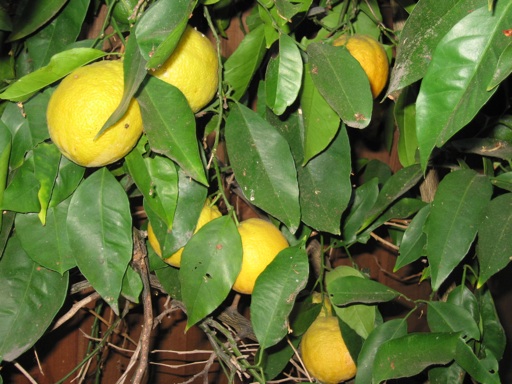
This photo is a picture of a Valencia orange tree growing in our yard. I am still harvesting oranges from this tree in late September. Valencia oranges typically ripen in mid-summer in our area. Yet, unlike many other types of fruits, Valencia oranges do not need to be picked soon after they ripen. I am amazed at how well Valencia oranges maintain their quality, even after remaining on the tree for months after ripening. Because they last on the tree so long, we can focus on eating fruit from our peach and pear trees in August, while we save the oranges for a later harvest.
Valencia oranges are tasty and juicy fruits. We often use them to make fresh orange juice. Some of them are great for fresh eating as well. Although, I have found that our Valencia oranges are generally not as consistently good for fresh eating as the oranges from our navel orange bush. The navel oranges are nearly always tasty, sweet, and tender. On the other hand, my experience has been that Valencia oranges are easier to grow than navels. Valencias don’t seem to require as much care as navels.
September 22 2008 | Oranges | Comments Off on Valencia Oranges
Next »