Archive for August, 2008
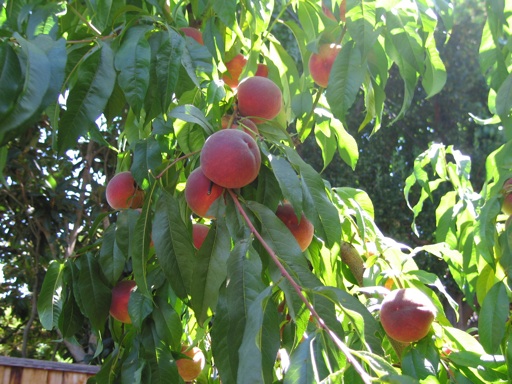
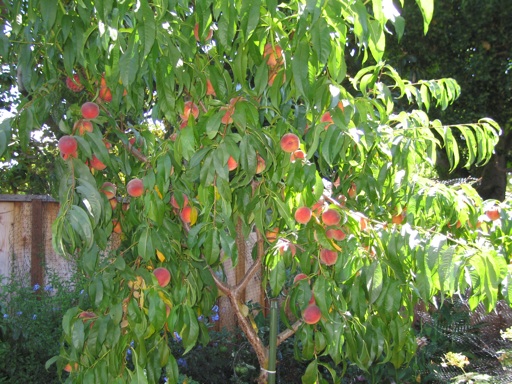
The peaches are ripening on the 6 year old O’Henry peach tree in our yard this week. The tree had about 200 peaches. That’s too many for me and my partner to eat before they rot. After giving some away, I still have a lot left. So I am going to turn a bunch of them into jarred peach preserves.
The peaches are tasty, but they are small in size, much smaller than last year’s crop. I think I should have thinned the fruit more. I waited too long to thin this year (July), and I didn’t remove enough of the pre-ripened fruit from the tree. Last year, this tree had far fewer peaches, but they were much larger. I think the peaches tasted better and were juicier last year.
Next year, I plan to prune the tree much more than I did this year. Peaches and nectarines fruit on one year old branches. If I remove more of the branches in the dormant season, the tree should have less fruit next year. I also plan to thin aggressively in May and June to reduce the crop to about 100 fruits.
O’Henry peaches are a good variety overall. They don’t rot easily or split, and I have never seen insects eating them. Although squirrels love them, so the tree needs to be netted.
My mom bought and planted this tree in our yard after she bought O’Henry peaches at a fruit stand and really enjoyed them. The tree has grown incredibly fast in the past two years, after I transplanted it from the front yard to a sunnier spot in the back yard. I waited too long in the dormant season to transplant it. The tree was just starting to bloom. It went into shock and nearly died. I fertilized and watered it excessively the spring and summer after that, and it came back in a big way. Now, it’s one of the best looking fruit trees in our yard, and it requires very little care. Besides watering and occasional fertilizing, the only special care I give it is dormant season spray for peach leaf curl and of course netting.
August 23 2008 | Peaches/Nectarines | Comments Off on O’Henry Peaches
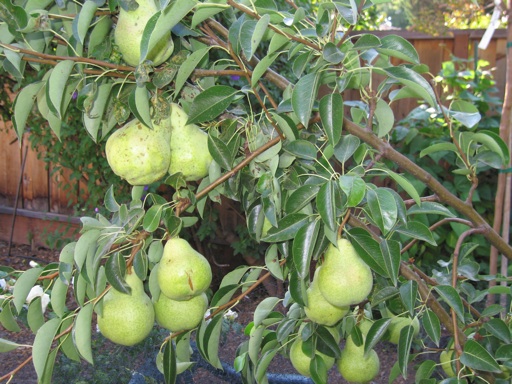
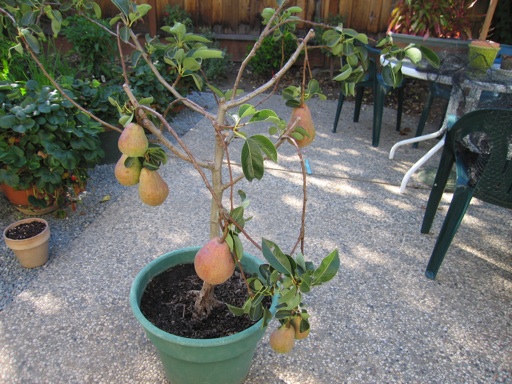
This is a picture of a small Bartlett pear tree in our yard. It is full of pears this year. I counted about 130. Mid-August is usually the time to harvest Bartlett pears in central California. Last year, this tree did not have a single pear.
The branches of the tree are so full of fruit, I have held them up using plastic chairs to keep the fruit off the ground. The branches of this tree are weak and spindly. A few of the branches broke off under the weight of the fruit. I have noticed that Bartlett pear trees often have an unattractive form. Overall, our tree is not a very good looking tree. But the quality of the pears it produces makes it well worth growing. The texture of the fruit is incredibly soft and buttery, and the flavor is sweet.
I am picking the pears before they are ripe and then letting them ripen indoors. Pears do not ripen properly on the tree. The fruit ripens from the inside out. If they are left on the tree until they seem ripe, the fruit may be rotten inside.
Color is one indication of when to harvest. Bartlett pears are usually ready to pick when they are a pale green color. Another technique involves lifting each fruit into a horizontal position. If the pear comes off the branch easily when lifted up, it is ready to harvest.
The fruit ripens in about 7-10 days when indoors at room temperature. Bartlett pears turn from green to yellow as they ripen. When the top of the pear near the stem (or the bottom of the pear) is soft to touch, it is ready to eat.
Bartlett pears are one of my favorite fruits. The pears I have eaten from our tree and from my parent’s Bartlett pear tree are the sweetest pears I have ever tasted.
Sometimes, when I have a large harvest of Bartlett pears, I store a portion of them in the refrigerator. Pears can be stored for weeks in refrigeration, which slows down the ripening process, and then brought back to room temperature to ripen fully. However, the Bartlett pears that I have eaten after refrigeration were not as sweet as the ones that were ripened at room temperature right after harvest.
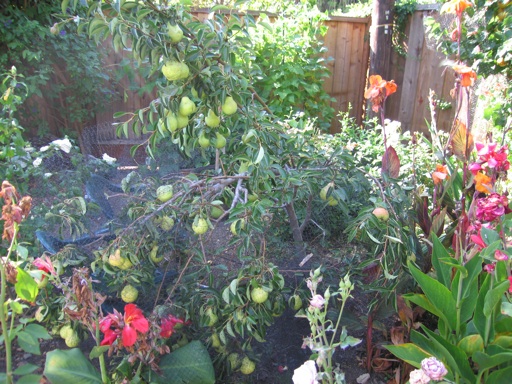
The bottom picture is a small max’s red bartlett pear tree growing in a pot. It’s producing pears for the first time this year. The red bartlett pears I have eaten were even sweeter than yellow Bartlett pears. I can’t wait to taste these.
August 15 2008 | Pears | Comments Off on Bartlett Pears
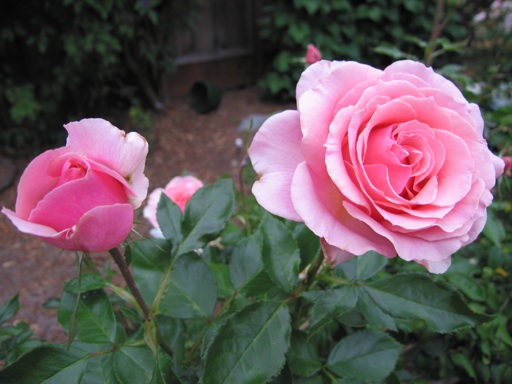
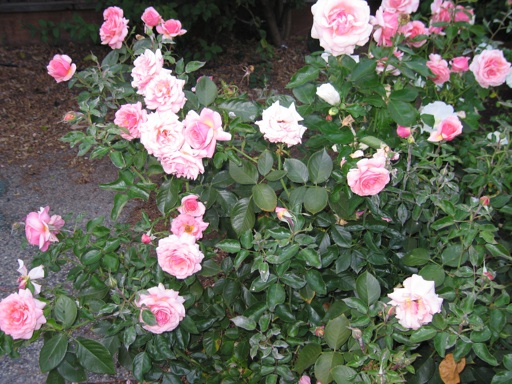
These are pictures of another great rose that is blooming in our yard. I don’t know what variety of rose it is. It was growing here when we moved in, and I can’t find a tag on it. I like this rose, because its flowers last for several days, sometimes over a week, before they fade. Also, the flowers don’t get sunburned on hot days like so many of our other roses. It has thrived in our yard with a minimal amount of care. It gets watered every day by a drip system for about ten minutes. I fertilize it about twice a year, once in spring and once in summer.
August 10 2008 | Roses | Comments Off on Unknown Pink Rose
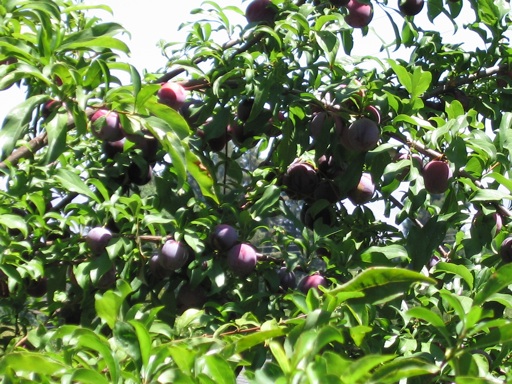
This is a picture of a Santa Rosa Plum tree growing in my parents’ yard. It is full of plums this year, much more than it usually has. Temperate climate fruit trees like plums need a lot of winter chill hours (hours below 45 degrees) to bloom and set fruit. I think part of the reason this tree is producing so heavily is that last winter was colder than normal – at least in terms of night time low temperatures.
In addition, 2008 was a very dry spring in California. It was one of the driest springs on record. Heavy spring rains can reduce fruit production by damaging the blossoms or preventing them from getting pollinated. The dry weather has probably increased fruit tree production this year.
2008 has also been a bountiful year for fruit trees in my yard too. My peach, pear, nectarine, apricot, and apple trees are full of fruit. I don’t have a plum tree right now. In general, plums are not at the top of my list of favorite fruits, but Santa Rosa plums do have a nice sweet-tart flavor. They are mainly fresh eating plums, because the fruit flesh clings tightly to the seed (clingstone), making it hard to cut out for cooking. I would recommend them to anyone considering planting a fruit tree in their yard. One nice thing about plums is that they tend produce fruit at a younger age than other fruit trees, such as pears.
August 10 2008 | Plums | Comments Off on Santa Rosa Plums
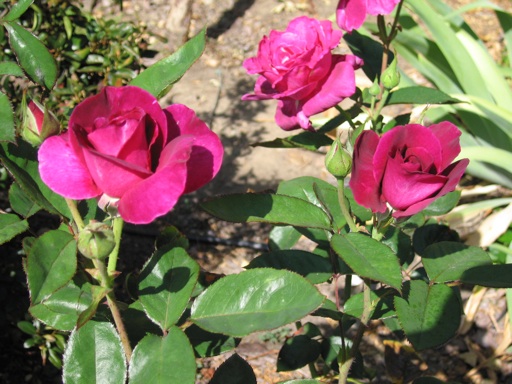
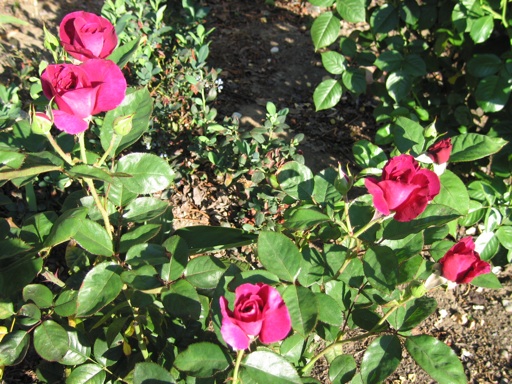
These are pictures of an Intrigue rose bush that is blooming in our yard this week. Intrigue is one of my favorite hybrid tea roses. It has the perfect rose shape as it’s opening. Although, it tends to fade quickly soon after it’s fully opened, and the flowers often get sunburned in hot weather.
I planted this rose bush as a bare root rose about 3 years ago. It grew poorly the first 2 years, probably because it was only getting about 2 hours of direct sunlight a day, and it wasn’t getting watered enough.
Roses are water hungry plants. I now water all of my roses daily with a drip system from April through October. Also, I moved this Intrigue rose bush to a new loaction that gets about 6 hours of direct sun daily. Now, it’s doing great. It’s tripled in size in just the past year.
August 06 2008 | Roses | Comments Off on Intrigue Rose
« Prev - Next »