Archive for August, 2008
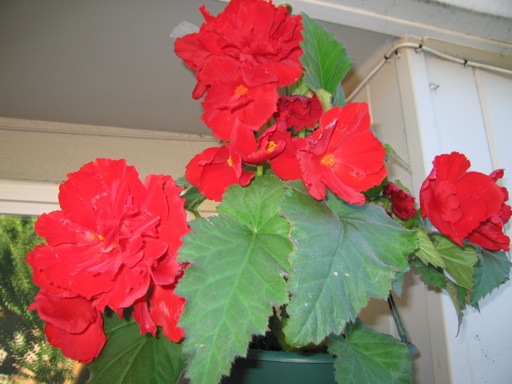
I have not had any luck growing begonias in the ground. Snails always devour nearly every portion of the plant. I have the same problem with dahlias. Snails consume the leaves so quickly as they grow above the ground that the tuber does not have a chance to develop a stem.
A few months ago, I purchased the above-pictured full-grown begonia from a nursery and planted it in a hanging container. I figured the snails were unlikely to get to it here. So far, I have not noticed any holes in the leaves. It continues to bloom and look great.
August 31 2008 | Begonia | Comments Off on Red Begonia
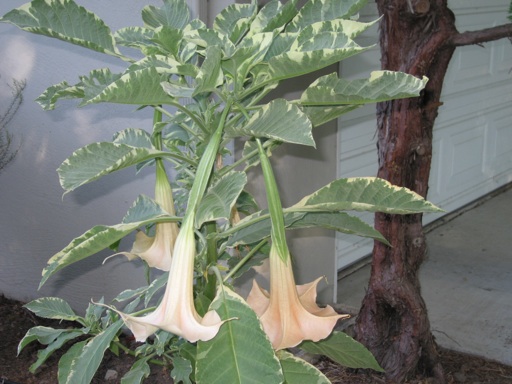
This is a picture of a peaches and cream brugmansia we are growing. I planted it about 3 years ago. It grew well for about a year and half, and it bloomed spectacularly on at least one occasion.
In January 2007, it froze to the ground during cold weather. Since then, it has slowly been making a come back. A few days ago, it started blooming for the first time since the freeze.
I really like this brugmansia, because of its peachy colored flowers and variegated leaves. It does not grow as fast or bloom as much as the Charles Grimaldi brugmansia. Even so, it makes an attractive small shrub.
I put copper tape around the base of the trunk to keep the snails from eating the leaves. Without some form of snail control, snails eat many holes in the leaves, making the plant look unattractive.
I water this brugmansia regularly. I have it growing in a spot that only receives filtered sunlight in the afternoon and mostly shade in the morning. Although many sources say to plant brugmansia in full sun, my experience has been that brugmansia wilts frequently in full sun on hot summer days. I tend to think a shady or partly sunny spot is more ideal for brugmansia.
August 31 2008 | Brugmansia | Comments Off on Peaches and Cream Brugmansia
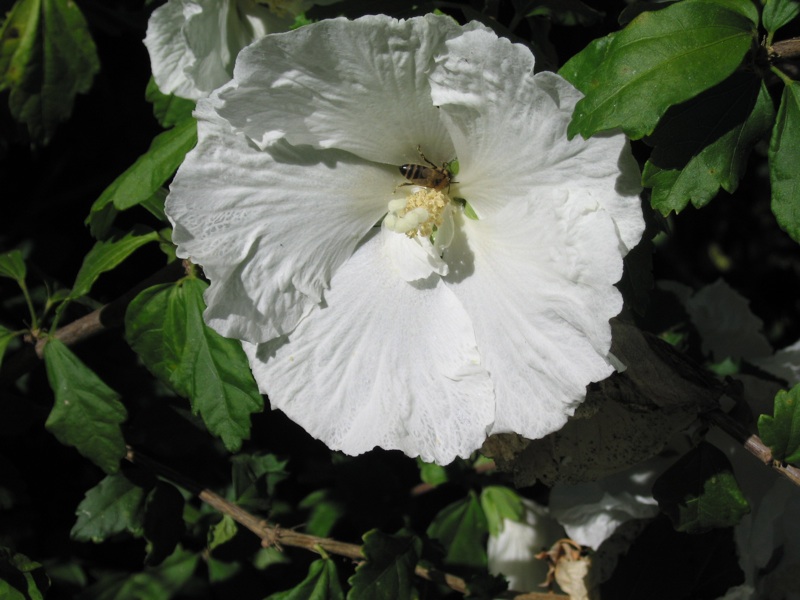
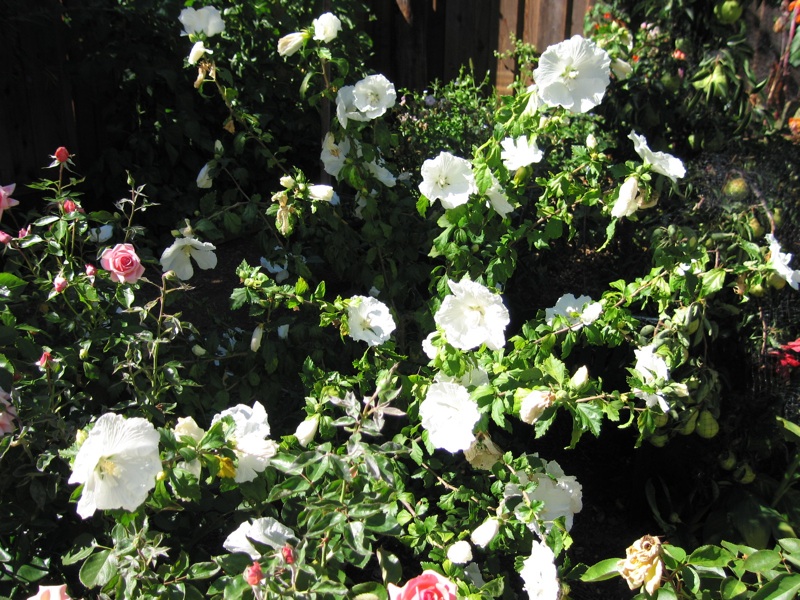
The above-pictured white rose of sharon has been blooming in our backyard for over a month. Every time I go outside to look at it, bees are buzzing around its flowers. I have not noticed a decline in the bee population in our backyard.
Apparently, certain flowers attract bees more than others. Rose of sharon appears to be very attractive to bees. My guess is that growing a diversity of flowering plants is probably good for prompting a healthy local honey bee population. Most flowering plants only bloom for a few weeks out of the year. Growing a diversity of flowers gives bees a food source over a longer season.
This rose of sharon bush was planted by the previous owners. Its flowers are attractive, and it has bloomed every summer. Also, it requires very little care. I don’t think I have ever fertilized it, and it doesn’t seem to require a lot of water. Rose of sharon is also very frost tolerant. It can easily withstand temperatures in the 20s, and probably much lower.
August 29 2008 | Rose of Sharon | Comments Off on White Rose of Sharon
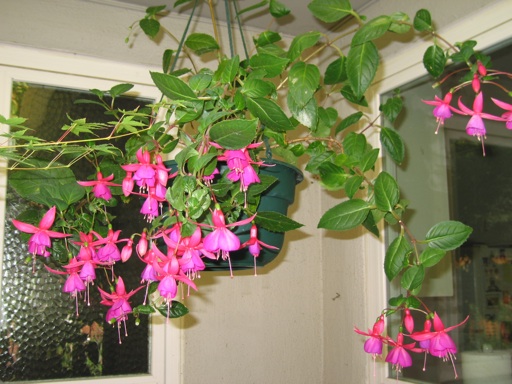
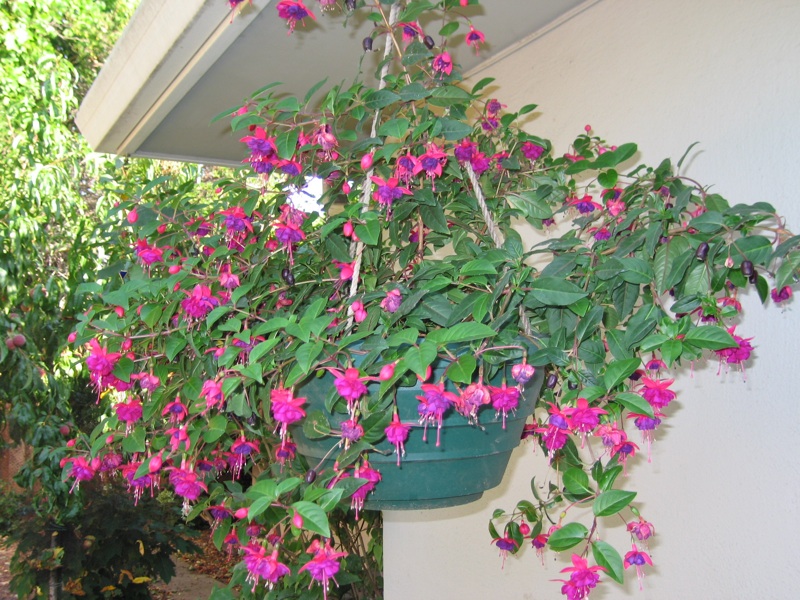
It seems that a garden is not complete without at least one plant in a hanging container. Fuchsias are one of the best suited plants to grow in hanging containers. Growing them in hanging containers makes it easier to view them. One can just look up and view the flowers as they droop downward.
Some varieties of fuchsias have erect branches and others having drooping branches. I think that the types of fuchsias with drooping branches look especially attractive in a hanging basket.
These are pictures of fuchsias that are blooming outside our kitchen window right now.
Fuchsias are frost sensitive plants. They should be brought inside during freezing weather in the winter if they are being grown as perennials. We bought the above-pictured fuchsia in 2007. It survived the entire winter of 2007-2008 outside without being brought inside. The temperatures here did not dip too far below freezing last winter. This fuchsia is now in its second summer.
The below-pictured fuchsia was purchased from a nursery last spring, looking nearly like what it does now. It looked great for weeks until it stopped blooming. But I managed to get it to bloom again. The secret, I have learned, to getting our fuchsias to bloom multiple times each year is repeated applications of fertilizer. I apply water soluble fertilize to them about once every two weeks. The fertilizer seems to kick start another bloom a few weeks after the last one has finished. Now I am wondering whether I can keep repeat blooms going through autumn this year.
August 26 2008 | Fuchsia | Comments Off on Hanging Fuchsias
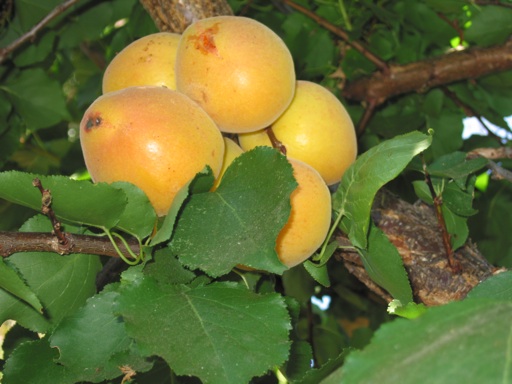
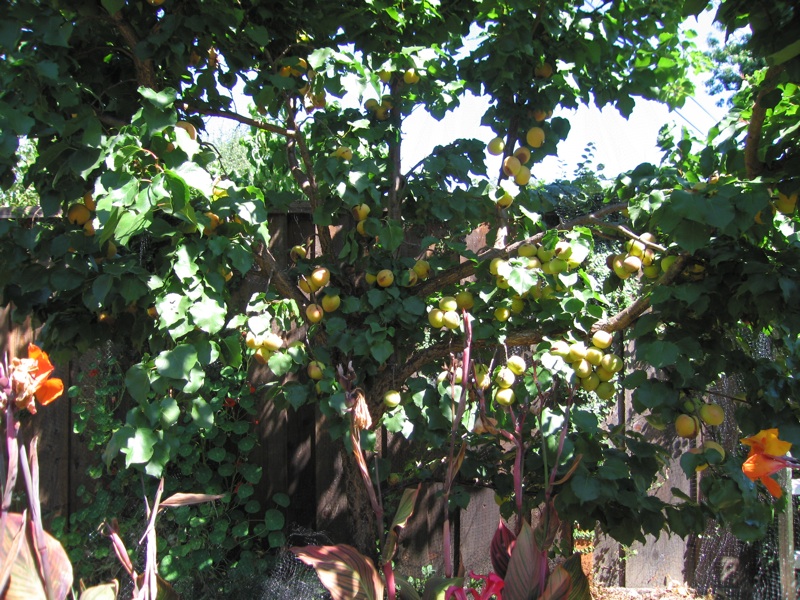
August is the high season for fruit in our backyard. In addition to peaches and Bartlett pears, I also harvested a bunch of autumn royal apricots this week. When I planted this apricot tree six years ago, I was hoping that it would live up to its name and that the apricots would ripen in the fall. This year is only the second year this tree has produced fruit, and both years the fruit has ripened in August. In retrospect, it probably would have been better to select fruit trees with different ripening schedules so that I am not overwhelmed with too much fruit from multiple trees. On the other hand, I would rather have too much fruit than too little!
Unfortunately, most of the apricots on this tree split a few weeks ago and then began to rot at the line of splitting, before they were even ripe. The cluster in this picture is one of the few on the tree that reached ripeness without splitting.
There were about 150-200 apricots on the tree 2 weeks ago, but I was only able to harvest about 3 dozen apricots that were edible. They weren’t as flavorful as Blenheim apricots. Instead of eating them fresh, my mom and I turned them into a dozen jars of apricot jam.
Recently, I have noticed that many recipes for apricot desserts call for apricot jam, instead of fresh apricots. Apparently, apricot jam can be useful for much more than spreading on toast.
August 24 2008 | Apricots | Comments Off on Autumn Royal Apricots
Next »